
35 Parenting Habits From the 1980s That Deserve a Second Look Today

Would you like to save this?
Parenting in the 1980s looked different from the approach many families take today. Kids rode bikes without helmets, stayed out until dark, and settled disagreements without constant adult supervision. Looking back at these habits gives you a clearer picture of how much parenting norms have shifted over the past four decades.
Some of these older practices get dismissed as outdated or careless, but not all of them deserve that label. Many 1980s parenting habits actually encouraged independence, resilience, and problem-solving skills that benefit children well into adulthood. You might find that certain methods your own parents used align with what child development experts recommend today.
This article walks you through 35 parenting habits from that decade worth reconsidering. You’ll see which practices hold up under modern scrutiny and which ones offer lessons still relevant for raising kids now.
1. Letting children play outdoors without scheduling every minute

In the 1980s, you probably spent afternoons outside without a set plan or an adult directing your every move. Parents sent kids out the door and expected them back by dinner, trusting them to fill the hours themselves.
That unstructured time had value. You learned to negotiate rules with other kids, settle disagreements, and come up with games on the spot. No coach or parent was there to step in and solve problems for you.
This approach doesn’t mean ignoring safety. It means recognizing that free play, without constant adult input, builds skills that structured activities often don’t: independence, creativity, and the ability to handle boredom.
Giving your children blocks of unscheduled outdoor time, even now, can offer some of these same benefits, provided you still know where they are and set reasonable boundaries.
2. Encouraging neighborhood play with clear check-in times

In the 1980s, you likely headed outside after breakfast and didn’t return until a set time, often signaled by a shout from the porch or a specific hour on the clock. Parents didn’t track your location minute by minute. Instead, they set boundaries around time, not location.
This approach gave you room to solve problems, negotiate with other kids, and manage your own schedule. You learned to judge how long it would take to get home and plan accordingly.
Today, you can apply the same principle without abandoning modern safety tools. Set a return time, let your child roam within agreed limits, and use a phone for check-ins rather than constant monitoring.
This method builds independence while keeping communication open. You still know where your child generally is, but you’re not managing every moment of their time outside.
3. Giving age-appropriate freedom to walk or bike familiar routes

In the 1980s, you likely walked or biked to school, a friend’s house, or the park without an adult along for the ride. Parents judged readiness by age and familiarity with the route, not by a fixed rule for every child.
This approach taught you to read traffic, judge distances, and make decisions on your own. You learned what to do if you got a flat tire or ran into bad weather, because no one was there to solve it for you.
The routes themselves mattered. Kids started with short, familiar paths and moved to longer ones as they gained experience.
This habit holds up today. Letting your child handle a known route, even a short one, builds real-world judgment that supervised trips can’t fully replicate.
4. Allowing children to solve small disagreements before stepping in

In the 1980s, you likely settled arguments with siblings or friends on your own. Parents often stayed out of minor squabbles unless things escalated.
This gave you room to practice negotiation. You learned how to state your side, listen to the other person, and reach some kind of compromise.
Researchers refer to this as peer conflict resolution. Studies show that children get better at managing disagreements when adults step back at the right moments instead of intervening immediately.
That doesn’t mean every conflict was left alone. But smaller disputes, like who got the bigger slice or whose turn it was next, were treated as low-stakes learning opportunities.
By working through these moments yourself, you built skills in patience and problem-solving. Those skills carried into adulthood, shaping how you handle disagreements today.
5. Making room for unstructured play without adult direction
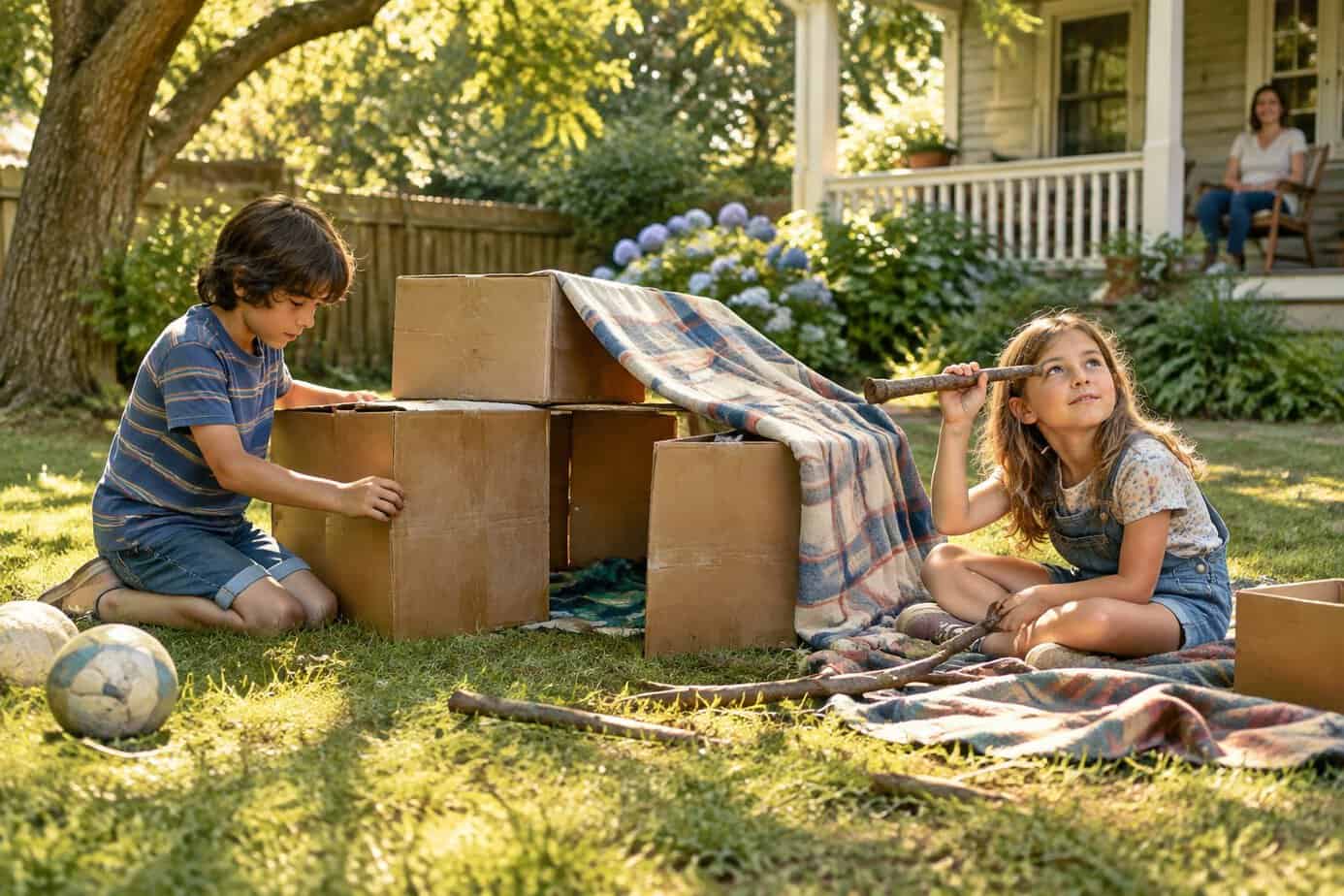
In the 1980s, you were likely sent outside after breakfast with instructions to come back when the streetlights turned on. No one scheduled your games, refereed your disputes, or supervised your choices. You figured out the rules yourself, and you dealt with boredom by inventing something to do.
That gap between structured activities gave you room to practice decision-making without an adult stepping in. Research on unstructured play points to its role in building executive function skills like impulse control and planning.
The American Academy of Pediatrics reaffirmed this in 2026, naming free play essential for these same skills. Compare that to today, when many kids get less than 30 minutes of unsupervised outdoor time daily. Bringing back this habit doesn’t mean abandoning supervision entirely. It means stepping back enough to let your kids make their own choices.
6. Keeping simple household chores part of everyday life
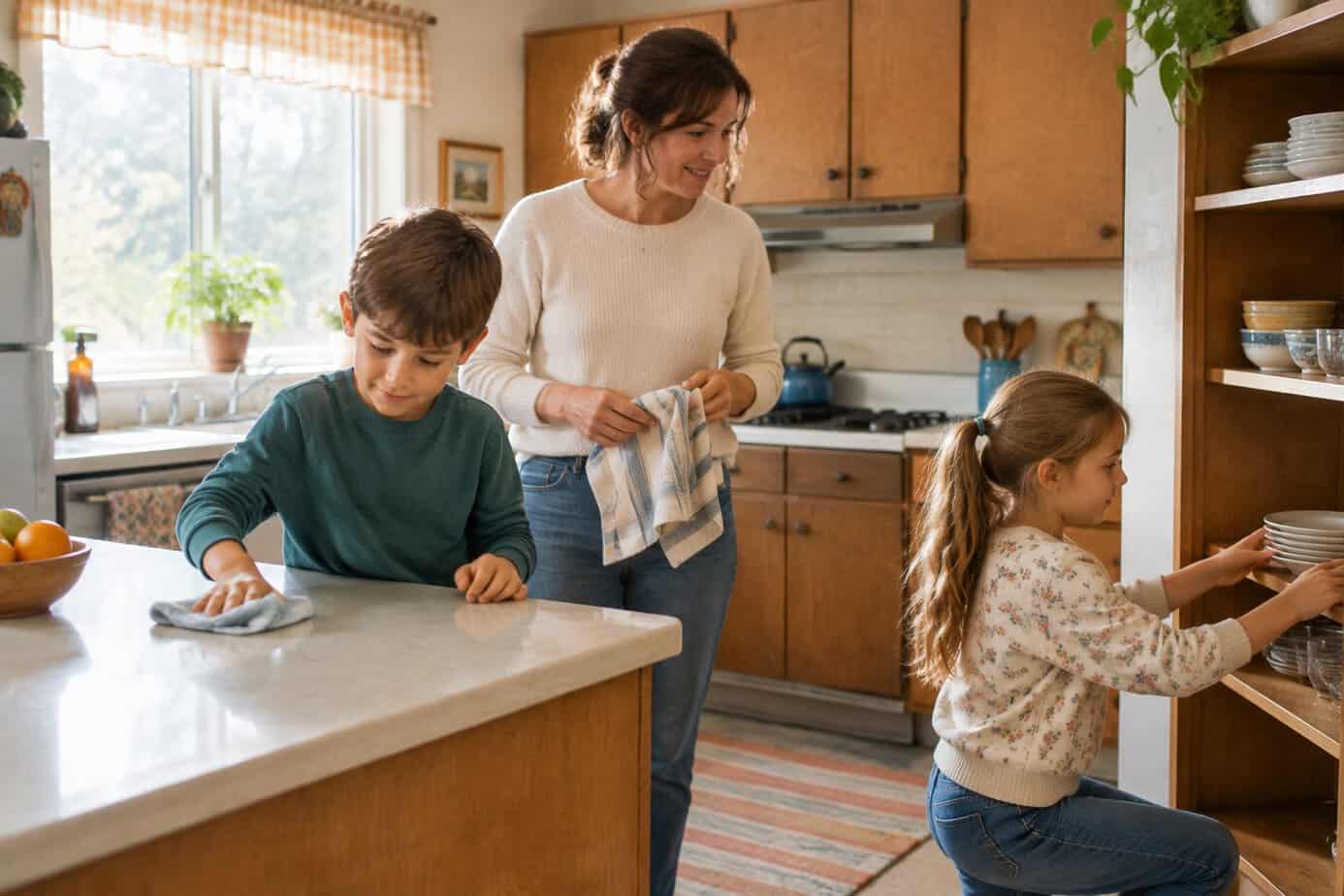
In the 1980s, you likely had chores before you understood why they mattered. Setting the table, taking out trash, folding laundry, these weren’t optional extras tacked onto your day.
With more parents working outside the home, families relied on kids to share the load. Chores weren’t framed as punishment or favors. They were simply part of how a household functioned.
This approach taught you something tablets and schedules can’t replicate: consistency builds competence. You learned to complete tasks without constant supervision or praise.
If you’re raising kids now, consider reintroducing this habit. Give your child a specific, repeated task and let them own it. You don’t need elaborate charts or rewards systems. Just consistent expectations, repeated daily, until the task becomes automatic rather than a battle.
7. Teaching children to prepare easy snacks and meals

In the 1980s, kids learned to make their own snacks early on. With both parents often working, you were expected to handle basic food prep after school without supervision.
You probably learned to work a toaster, a microwave, or a stovetop burner before you turned ten. Simple tasks like spreading peanut butter, pouring cereal, or heating up leftovers gave you a sense of independence.
This habit taught practical skills that stuck. You understood portion sizes, basic safety around heat, and how to follow simple steps without an adult guiding you.
Letting children handle small kitchen tasks today still builds confidence and reduces reliance on packaged convenience foods. It also means fewer “what’s for snack” questions directed at you during busy afternoons.
8. Expecting children to help tidy shared spaces
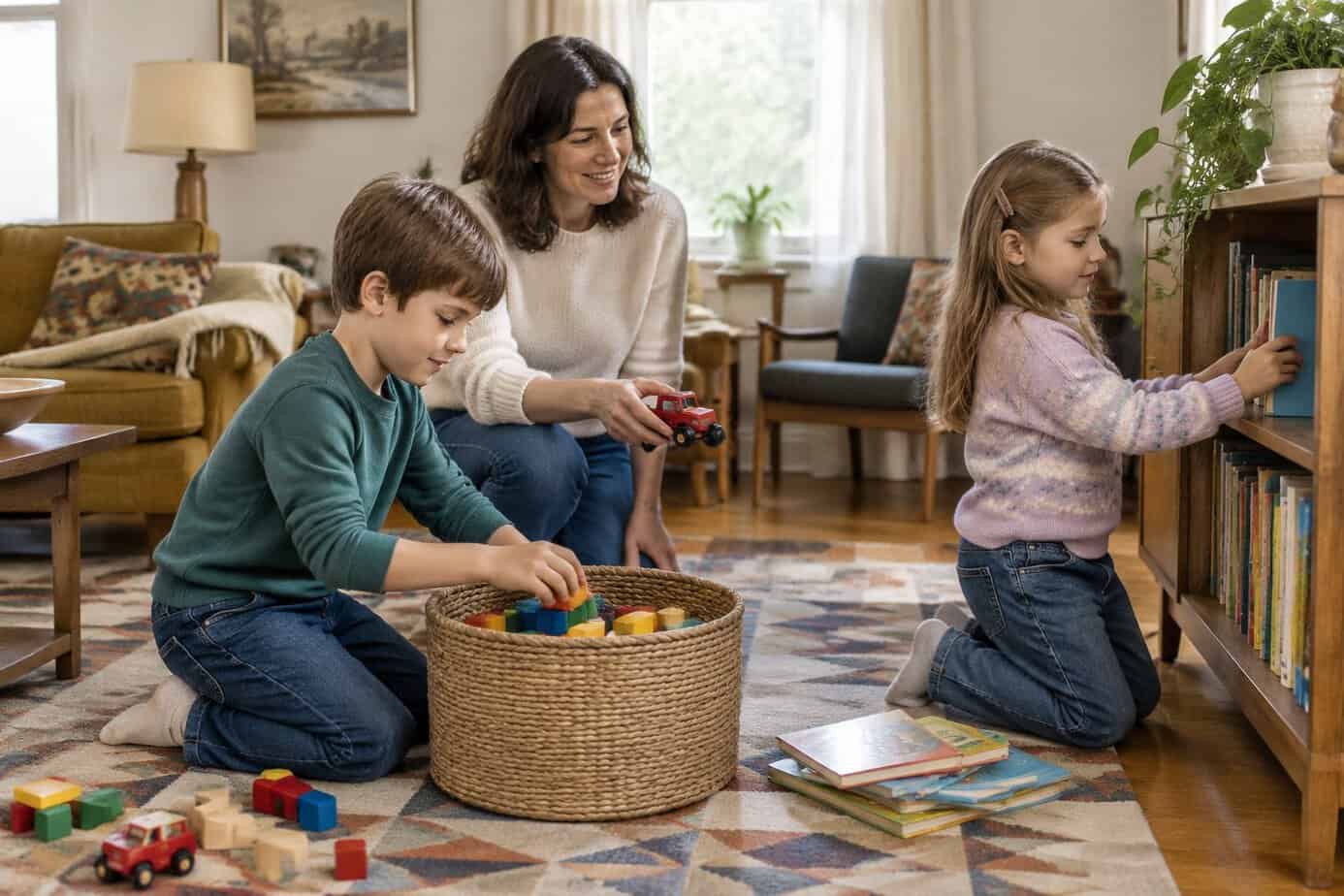
In the 1980s, you weren’t exempt from cleaning up the living room just because the mess wasn’t entirely yours. If toys ended up in the hallway or dishes piled up in the den, you were expected to pitch in regardless of who made the mess.
This approach treated the home as a shared responsibility rather than a collection of individual territories. You learned that common areas required common effort.
There was little patience for the argument that a mess belonged to someone else. Parents focused on the fact that everyone used the space, so everyone helped maintain it.
This habit taught practical cooperation. You picked up on the idea that households function better when work isn’t divided strictly by ownership.
Bringing this back doesn’t require rigid rules. It simply means expecting contribution to shared spaces as a normal part of family life, not an optional favor.
9. Giving children regular chances to care for pets

In the 1980s, you were likely assigned pet care duties as part of your regular household responsibilities. Feeding the dog, cleaning the fish tank, or walking around the block with a leash in hand taught you accountability without anyone explaining the psychology behind it.
Pets did not care about excuses. If you forgot to fill the water bowl, the consequences were immediate and obvious.
This approach gave you practical experience with responsibility that went beyond chores like making your bed. You learned to read another creature’s needs and respond to them consistently, even when you did not feel like it.
Researchers who study child development have found that these caretaking tasks can support empathy and problem-solving skills. Your parents probably were not thinking about any of that. They just wanted help with the dog.
10. Letting children experience manageable consequences

In the 1980s, if you forgot your homework or lost your jacket, you dealt with the result yourself. Parents rarely stepped in to fix small mistakes.
This approach taught you that actions have outcomes. A missed assignment meant a lower grade, not a parent calling the school to argue.
The consequences were kept within reason. You weren’t left to handle anything dangerous or overwhelming, just everyday slip-ups that came with everyday lessons.
You learned to plan ahead, double-check your things, and think before acting. These lessons stuck because you felt them directly, not because someone explained them to you.
Today, parents often intervene quickly to prevent any discomfort. Bringing back manageable consequences gives you room to build judgment and responsibility through real experience, not just instruction.
11. Encouraging persistence when a task feels difficult

In the 1980s, quitting wasn’t usually an option. If you struggled with homework, a chore, or learning to ride a bike, you were often told to keep trying rather than being handed an immediate solution.
This approach had real value. Pushing through frustration builds tolerance for discomfort, and that tolerance matters later in life.
You can apply this today without the harsher edges some 80s households had. Break a hard task into smaller steps so your child sees progress instead of just difficulty. Acknowledge the struggle out loud, then point them toward the next small action.
Praise the effort itself, not just the outcome. Consistent, specific encouragement works better than pressure or lectures.
The goal isn’t to make tasks harder than they need to be. It’s to help your child learn that discomfort is temporary and effort pays off.
12. Praising effort and follow-through, not only achievement

In the 1980s, you were more likely to hear “good job finishing that” than “you’re so smart.” Parents of that era often praised the work itself, not just the result.
This approach lines up with what later research found. Studies on “process praise” show that recognizing effort and strategy builds stronger motivation than praising talent or outcomes alone.
When you praise follow-through, you teach that persistence matters. A child who hears this learns that finishing a task has value, even if the result isn’t perfect.
This doesn’t mean ignoring achievement altogether. It means pairing recognition of success with acknowledgment of the work behind it.
You can apply this now by noticing the process your child used, not just the final score or grade. That shift helps build resilience and a steadier sense of motivation over time.
13. Making family meals a regular time to connect

Would you like to save this?
In the 1980s, family dinner was treated as a fixed part of the day, not an optional event. You sat at the table together, often without a television on, and talked about what happened that day.
This routine gave you a built-in chance to share details about school, friends, or problems you were facing. Parents used the time to ask questions, correct behavior, and pass along basic manners.
There was no expectation of entertainment or distraction during the meal. The focus stayed on the food and the conversation happening around it.
You can bring this habit back by setting a consistent time for meals and limiting phones or screens at the table. It doesn’t require elaborate cooking or long sit-downs. Even a simple meal, eaten together on a regular schedule, gives your family a reliable point of contact each day.
14. Sharing stories about family members and earlier generations

In the 1980s, you likely heard stories about grandparents, great-aunts, or relatives you never met. These stories came up at dinner tables, during car rides, or on holiday visits.
You learned where your family came from and what earlier generations experienced. This gave you a sense of identity beyond your own immediate life.
Parents in that era often repeated these stories more than once. You heard about hardships, achievements, and ordinary daily life from decades earlier.
This practice gave you context for your own upbringing. You understood that your parents’ choices were shaped by their own childhoods and family history.
Bringing this habit back means setting aside time to talk about relatives and family history with your own kids. It costs nothing and requires no special occasion.
You give your children a stronger sense of where they fit into a larger family story.
15. Reading aloud together, even after children can read independently

In the 1980s, parents often kept reading aloud to their kids well past the point where those kids could sound out words on their own. It wasn’t just a habit for toddlers.
This practice has real backing. A child’s listening comprehension typically stays ahead of their independent reading level until around eighth grade, which means you can introduce more complex vocabulary and ideas through read-alouds than your child could access alone.
The benefits extend beyond vocabulary. Reading together supports oral language skills, builds comprehension, and keeps kids engaged with stories they might not pick up on their own.
It also gives you a shared activity that doesn’t require a screen. If you stopped reading aloud once your child learned to read solo, bringing it back — even occasionally — can still offer value.
16. Keeping library visits and independent reading part of family life

In the 1980s, trips to the library were a normal part of your week, not a special event. You picked out your own books, got a library card as soon as you could write your name, and read whatever interested you without much adult input.
Parents of that era treated independent reading time as a given, often setting aside quiet time after dinner or before bed for it. Nobody tracked minutes or assigned reading logs; you just read because the house was full of books and screens weren’t competing for your attention.
This habit matters now because reading habits formed early tend to stick. If you make library visits a regular outing instead of an occasional treat, you give your kids repeated chances to find books they actually want to read, which does more for long-term reading interest than any required list.
17. Encouraging hobbies that do not require screens
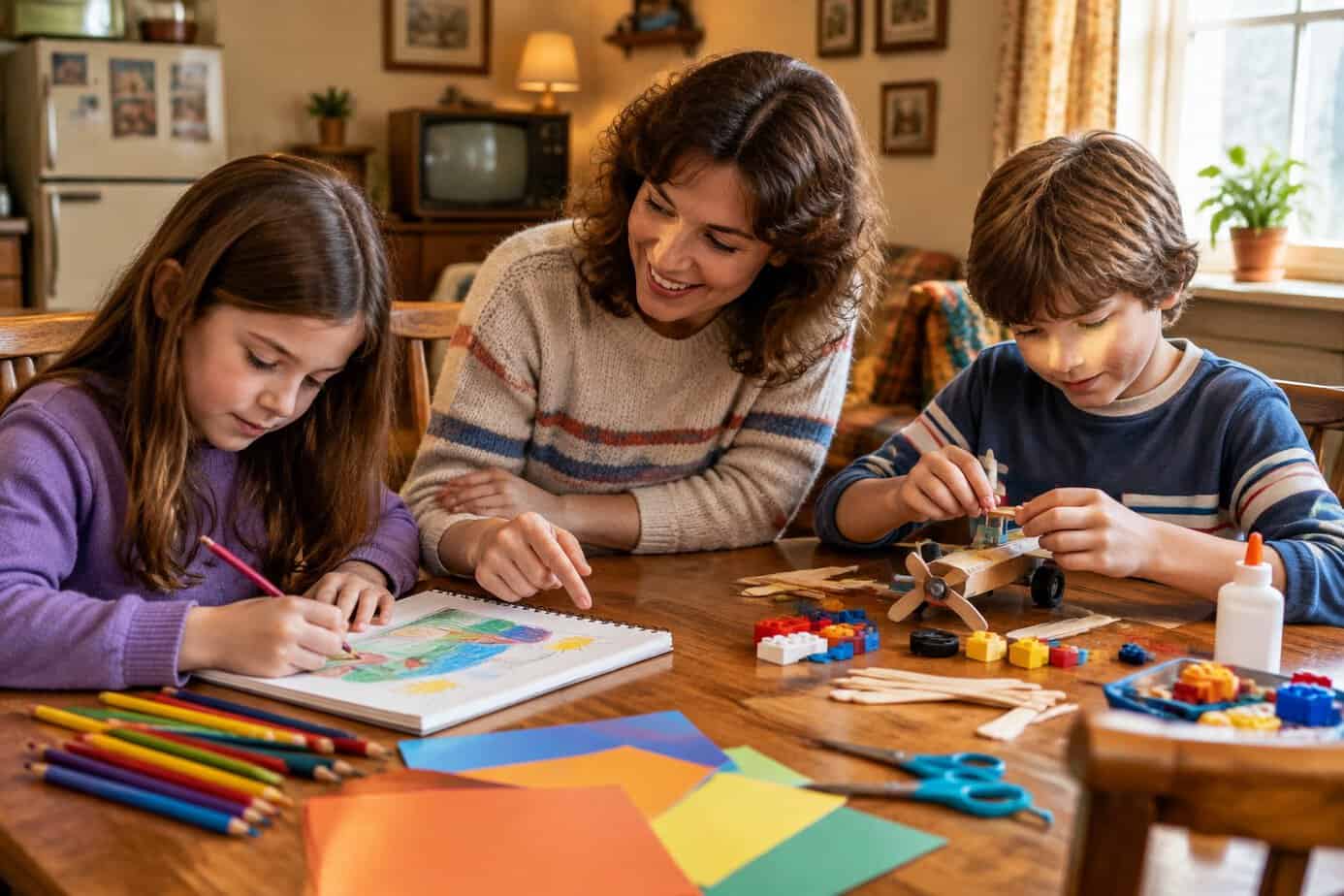
In the 1980s, you had hobbies that filled your free time without any screen involved. Building models, collecting stamps, drawing, and riding bikes were common choices.
Your parents expected you to find something to do on your own. Boredom was not solved for you; it pushed you toward activities that kept your hands and mind busy.
These hobbies built skills that lasted. Patience, focus, and creativity developed naturally when you worked on a puzzle or practiced an instrument.
You can bring this approach back for your own kids. Offering art supplies, building sets, or outdoor games gives them a break from constant screen use.
The goal is not to eliminate technology entirely. It is to balance it with activities that build different skills and give your child’s attention a place to rest.
18. Making things with household materials instead of buying a kit
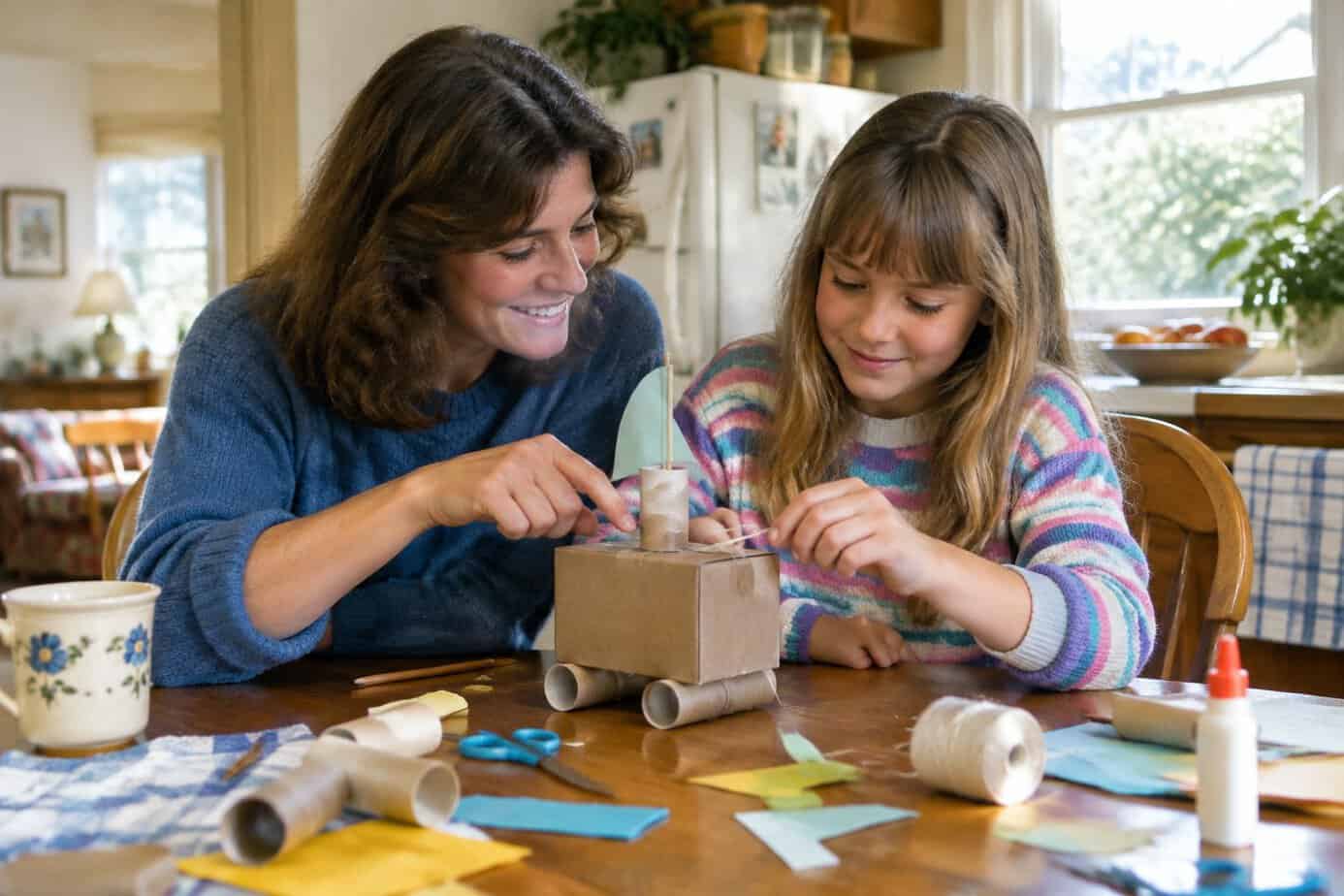
Before pre-packaged craft kits lined store shelves, you likely built things from whatever was in the kitchen or garage. Cardboard boxes became dollhouses. Flour and water turned into paste for papier-mâché. Old socks became puppets.
This wasn’t just about saving money, though that mattered too. You learned to look at ordinary objects and see potential rather than just function. A shoebox wasn’t trash; it was a diorama waiting to happen.
The process also taught patience and problem-solving. You had to figure out how to make a cereal box stand upright or how to get glue to hold fabric scraps together. There was no instruction manual.
This habit holds up because it builds resourcefulness. Kids today still benefit from knowing they can create something without a store-bought template guiding every step.
19. Letting children get bored and decide what to do next

In the 1980s, you weren’t handed a schedule of activities when you had nothing to do. You were told to figure it out yourself.
Boredom wasn’t treated as a problem that needed fixing. It was simply part of the day, and you were expected to work through it on your own.
This meant you had to rely on your own imagination. Maybe you built something, read a book you’d already read twice, or just sat and thought.
That unstructured time taught you to generate your own ideas instead of waiting for someone else to supply them. You learned to tolerate periods without stimulation, which is a skill that doesn’t get much practice when every moment is filled for you.
Giving your own kids that same stretch of empty time, without rushing to solve it for them, can still build the same capacity for self-direction.
20. Encouraging outdoor exploration while setting sensible safety boundaries

In the 1980s, you were likely sent outside after breakfast and expected back by dinner. Parents gave you a general area to stay within, then let you figure out the rest on your own.
This wasn’t neglect. It was a working system of loose limits paired with real independence.
You learned to judge distances, read weather, and negotiate with other kids without an adult refereeing every disagreement. Boundaries existed, but they were simple: stay in the neighborhood, come home when called, avoid certain streets.
Today, you can apply the same logic without abandoning modern safety standards. Set clear physical limits, agree on a check-in time, and then step back.
Letting your child handle minor risks on their own, a fall, a disagreement, a wrong turn, builds judgment that constant supervision doesn’t. The goal isn’t less safety. It’s less interference.
21. Teaching practical skills such as sewing on a button or using basic tools
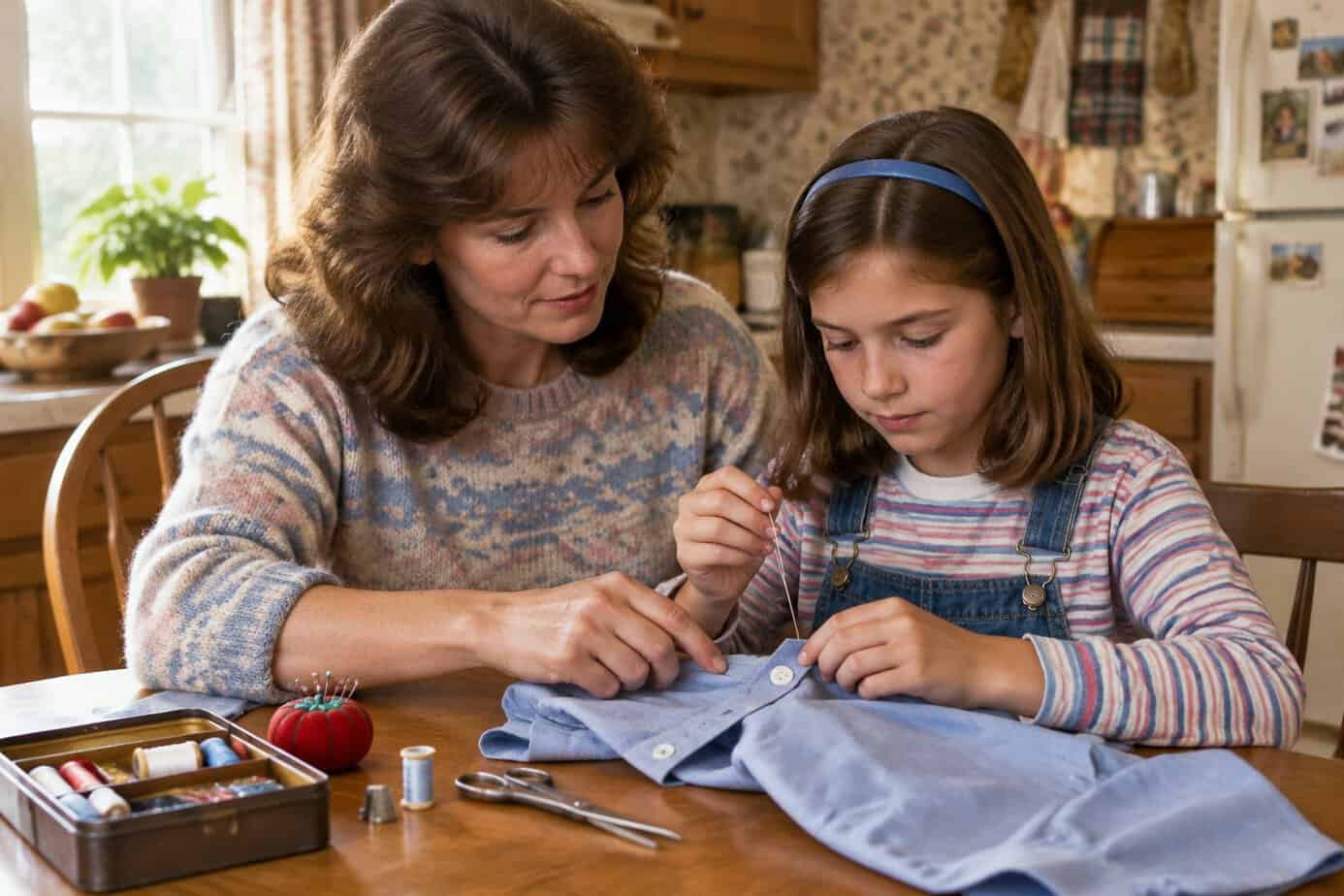
In the 1980s, you probably learned to sew a button, hammer a nail, or fix small household problems before you turned ten. These weren’t treated as optional extras. They were basic expectations.
Your parents handed you a needle and thread or a screwdriver and showed you once, maybe twice. After that, you were expected to manage on your own.
This approach built confidence in a practical way. You learned that small problems didn’t require outside help, and that mistakes were part of figuring things out.
Home economics and shop classes reinforced these lessons at school, giving you structured practice alongside what you picked up at home.
Today, you might find these skills less common, since convenience and specialized services have replaced some of that hands-on learning. Bringing this habit back doesn’t mean rejecting modern life. It means giving yourself, or your own kids, useful tools for daily independence.
22. Inviting children to help plan simple family activities

In the 1980s, you likely had a say in weekend plans or family outings. Maybe you helped choose the movie, the park, or the game for a rainy afternoon.
Parents of that era didn’t always script every detail. They asked for input and let kids weigh in on simple choices.
This approach gave you practice making decisions early on. It also meant you felt some ownership over family time, rather than just being along for the ride.
You can bring this habit back without much effort. Ask your children what they’d like to do this weekend or which activity sounds fun.
Keep the options realistic and within reason. A short conversation about plans teaches negotiation and compromise.
It also shows your children that their preferences matter, even in small decisions. Over time, this builds confidence and strengthens the sense that family activities are a shared effort, not something handed down from above.
23. Giving children small, meaningful choices in daily routines

In the 1980s, you might have offered your kids a few simple options each day. Would they wear the red shirt or the blue one? Did they want cereal or toast for breakfast? These decisions were small, but they mattered.
You weren’t trying to overload anyone with possibilities. A choice between two or three things was enough to give your child a sense of control without creating chaos.
This approach taught decision-making skills early on. Your children learned that their preferences counted, even in minor matters.
It also cut down on power struggles. When kids feel some ownership over their routine, they’re often more cooperative.
You didn’t need elaborate systems or charts to make this work. A quick question in the morning did the job just fine.
24. Setting consistent limits and explaining them calmly

In many 1980s households, rules stayed fixed from one day to the next. Bedtime was bedtime. Chores didn’t shift based on mood or negotiation.
That consistency gave you something to rely on. You knew what to expect, and that predictability built a sense of structure you could count on.
Explaining the reasoning, when it happened, usually came in a calm, matter-of-fact tone rather than a lecture. A parent might simply state the limit and move on, without drama or extended debate.
This approach holds up today because children still benefit from clear boundaries paired with steady, low-key communication. You don’t need to justify every rule at length, but a brief, calm explanation helps a child understand the reasoning rather than just the restriction.
The combination of firmness and composure, rather than firmness and force, is what made this habit worth revisiting.
25. Using natural consequences instead of harsh punishment

Would you like to save this?
In the 1980s, many parents let you face the direct results of your own choices rather than stepping in with a punishment. Forgot your homework? You dealt with the teacher’s response. Lost your allowance money? You simply had less to spend.
This approach differed from the spanking and strict discipline common at the time. Instead of imposing an unrelated consequence, parents allowed life itself to teach the lesson.
The reasoning was straightforward: experiencing a real outcome tends to stick with you longer than a lecture or punishment does. If you broke a toy out of carelessness, you didn’t get a replacement right away.
This method still holds value today. Letting consequences occur naturally, when safe to do so, helps you connect your actions to their results without added conflict or fear.
26. Apologizing to children when adults make mistakes

In the 1980s, many parents saw apologizing to a child as unnecessary. The parent-child hierarchy was treated as fixed, and admitting fault felt like a threat to authority.
You can take a more balanced approach now. Saying “I was wrong” or “I shouldn’t have raised my voice” doesn’t weaken your position as a parent. It shows your child that mistakes are normal and that owning them is part of being accountable.
This habit also teaches by example. When you model an apology, your child learns how to offer one themselves, rather than just being told to say sorry on command.
You’re not undermining your authority by doing this. You’re demonstrating that respect runs in both directions, not just from child to adult.
A short, sincere apology costs you nothing. It can, however, strengthen trust and show your child that honesty matters more than appearing infallible.
27. Making space for children to talk about difficult feelings

In many 1980s households, feelings were not a regular topic of conversation. If you grew up during this time, you may remember being told to stop crying or to toughen up instead of being asked what was wrong.
This wasn’t always intentional neglect. Many parents simply weren’t taught how to talk about emotions themselves, so they didn’t know how to guide their children through them.
Looking back, you can recognize the value of giving kids room to express sadness, fear, or frustration without judgment. Children who can name their emotions tend to handle stress more effectively as adults.
You don’t need therapy sessions at the dinner table. Just asking “how are you feeling about that?” and actually listening to the answer makes a difference. That small habit of making space, rather than shutting feelings down, is worth bringing back into your own parenting approach.
28. Listening without immediately trying to fix every problem

In the 1980s, when you came home upset, your parents often just listened. They didn’t jump straight into problem-solving mode or offer a list of solutions.
Sometimes they simply nodded, asked a follow-up question, or let you finish talking before responding. That pause mattered more than you probably realized at the time.
This habit taught you that not every problem needs an immediate fix. You learned to sit with frustration, think it through, and sometimes solve things yourself.
Today, the instinct to jump in with advice is strong, especially with constant access to information. But offering a solution too quickly can shut down a conversation before it really starts.
Listening first gives your child room to process their own thoughts. It also shows them their feelings are valid, even before a solution appears.
29. Offering comfort while still encouraging age-appropriate independence

In the 1980s, you got hugged when you were hurt, then told to go back outside and finish the game. Comfort wasn’t withheld, but it wasn’t dragged out either.
You learned that being upset and being capable weren’t opposites. A scraped knee got a bandage and a few words of reassurance, not an extended discussion about feelings.
This approach taught you to self-soothe after the initial comfort faded. You weren’t expected to handle everything alone, but you also weren’t expected to need rescuing from every minor setback.
The balance mattered. Too little comfort leaves you anxious; too much creates dependence on others to manage normal frustration.
Parents in that era trusted you to recover and move on. That trust, paired with real support when it counted, built a foundation you could stand on without constant backup.
30. Teaching children to ask a trusted adult for help

In the 1980s, you learned to identify specific adults you could turn to when something felt wrong. Parents pointed to teachers, neighbors, relatives, and police officers as safe options.
The lesson was simple and direct. If you got lost, felt scared, or faced a problem you couldn’t handle alone, you knew to find someone reliable rather than freeze up.
This habit built practical judgment. You learned to assess situations and recognize which adults were appropriate to approach.
Reviving this approach today means giving children a clear mental list of trusted people before they need it. You can walk through real scenarios with them, so the response becomes automatic rather than something they have to figure out under stress.
It also teaches children that asking for help isn’t a weakness. It’s a skill that keeps them safer in unfamiliar or difficult moments.
31. Practicing road and bike safety before granting more freedom

Before letting you ride around the neighborhood alone, your parents walked you through the basics. You learned hand signals, how to check for cars, and where it was safe to cross.
This wasn’t a formal program. It was usually a parent riding alongside you a few times, pointing out hazards along the route.
Once you showed you understood the rules, you earned more independence. That might mean riding to a friend’s house or the corner store without supervision.
The practice-first approach meant freedom was tied to demonstrated skill, not just age. You had to prove you could handle traffic and intersections before boundaries expanded.
This method still holds up. Teaching road awareness directly, then gradually increasing independence, gives you a clear way to judge readiness instead of guessing based on a calendar.
32. Using seat belts and age-appropriate car seats on every trip

In the 1980s, car seat use was inconsistent. Many states didn’t pass mandatory seat belt laws until later in the decade, and enforcement varied widely.
You might remember riding loose in the backseat or switching to a forward-facing seat earlier than today’s guidelines recommend. At the time, this wasn’t seen as careless. It simply reflected the safety standards of the era.
Today, you know more. Rear-facing seats, booster seats, and proper harness use are based on decades of crash data that didn’t exist in the 1980s.
Still, the underlying habit from that decade deserves credit: buckling your kids in every time, no exceptions. That consistency matters more than the specific seat type or position.
If you apply that same discipline now, paired with current safety research, you get the best of both approaches. The habit is good. The details just needed updating.
33. Keeping children away from secondhand smoke

Smoking around kids was common in the 1980s. You might remember adults lighting up in cars with the windows cracked, or at the dinner table while everyone ate.
This habit does not hold up well today. Secondhand smoke exposure has been linked to respiratory problems, ear infections, and other health issues in children.
What deserves a second look is not the smoking itself, but the lack of separation between adult habits and children’s spaces. Many parents at the time genuinely did not know the risks, since public health messaging on secondhand smoke had not caught up with the science.
If you grew up during this era, you likely remember smoky living rooms or long car rides filled with cigarette smoke. Today, you have more information available, and keeping that boundary between smoking and children is one habit that changed for good reason.
34. Supervising water play and teaching basic water safety

Would you like to save this?
In the 1980s, parents kept a closer eye on kids near water, without the distractions phones bring today. You watched from the pool deck or beach blanket, not through a screen.
Swimming lessons often started early, and parents reinforced basic rules at home: no running near the pool, no swimming alone, stay where an adult can see you. These lessons were simple and repeated often.
Supervision meant being physically present and paying attention, not just being nearby. Research on water safety still points to active, focused supervision as one of the most effective ways to prevent accidents.
If you grew up in this era, you likely remember clear boundaries around water. Revisiting that level of attentiveness today, especially in a world full of screen-based distractions, can make water play safer for your own kids or grandkids.
35. Setting clear rules for unsupervised time and emergency contact

In the 1980s, you likely had a specific set of instructions for when you were home alone or playing outside without an adult. Your parents gave you a short list of rules: don’t open the door for strangers, don’t use the stove, and come home when the streetlights turned on.
You also knew who to call in an emergency. A list of numbers was often posted near the phone, or you simply memorized them.
This approach taught you practical judgment. You learned to assess situations and act on clear instructions rather than waiting for constant supervision.
Today, this habit still holds value. Giving children specific rules and a clear emergency plan builds independence without leaving them unprepared. It’s a straightforward practice worth keeping, even as supervision norms have shifted.
Why Parenting Looked Different in the 1980s
Parenting in the 1980s was shaped by tighter community networks and safety standards that looked nothing like today’s guidelines. Your understanding of that era grows clearer when you examine how daily routines and risk assessments actually worked.
Family Routines and Community Expectations
Your neighborhood likely functioned as an extension of your household in the 1980s. Neighbors kept an eye on kids playing outside, and parents trusted that system without much hesitation.
Daily life ran on structure. You had set mealtimes, a curfew tied to the streetlights coming on, and chores that weren’t negotiable.
Schools operated with more autonomy too. Teachers handled classroom decisions, and parents generally stayed out of it, assuming professionals knew best.
Discipline reflected the era’s values:
- Spanking was widely accepted and rarely questioned
- Independence was encouraged early, often by age 7 or 8
- Respect for authority was taught as a non-negotiable value
- Outdoor play replaced constant supervision
How Safety Guidance Has Changed
Car safety looked completely different in your childhood if you grew up in the 1980s. Seatbelt laws were inconsistent across states, and car seats weren’t mandatory everywhere until later in the decade.
You might remember riding in the back of a pickup truck or sitting in the front seat without a second thought. Secondhand smoke exposure was also common, since smoking in cars and homes around children wasn’t widely discouraged yet.
Bike helmets weren’t standard equipment either. You rode without one, and so did most kids on your street.
Playground equipment included metal slides and high monkey bars with little padding underneath. Safety guidance has since shifted toward prevention-focused standards, backed by research on injury rates and long-term health outcomes.
Adapting Past Practices to Families Today
Some 1980s habits translate directly into modern routines, while others need adjustments to fit current safety standards and family structures. The goal is to keep what worked while removing what put kids at unnecessary risk.
Match Independence to a Child’s Readiness
Independence should be based on your child’s maturity, not a fixed age from decades past. A seven-year-old who walked to a friend’s house in 1985 isn’t automatically comparable to a seven-year-old today, since neighborhoods, traffic patterns, and social norms have shifted.
Start small. Let your child walk to a mailbox alone before expanding to a block, then a neighborhood.
Watch how they handle each step:
- Do they follow agreed-upon boundaries?
- Can they problem-solve if something unexpected happens?
- Do they check in without being reminded?
If yes, extend the privilege. If not, scale back and try again later.
Keep the Benefits Without Repeating the Risks
Many 1980s practices had real value but came with hazards that don’t need repeating. Unsupervised outdoor play, for example, built confidence and problem-solving skills, but it often happened without basic safety gear or emergency communication.
You can keep the core benefit while updating the method. A kid riding a bike across town alone is a good example: keep the bike, add the helmet, and give them a phone for check-ins.


